I had always heard Meadowlark Hills is for older adults, but when I moved in, I found out Meadowlark Hills keeps us young.
The Christmas Trains
December 4, 2025

Local not-for-profit focused on supporting people in living their best lives
Webster’s definition for the word “garden” just about covers everything: a plot of ground, usually near a house, where flowers, vegetables, or herbs are cultivated. Or, “a piece of ground or other space commonly with ornamental plants, trees, etc., used as a park or other recreational area, e.g., as an arboretum.” Or, “any beautiful, pleasing, restful piece of land.”
Forests, prairies, and perhaps both orchards and vineyards also would fit under Webster’s umbrella. Those individuals with some farm experience, or with dollar-wise upbringings, most likely link “garden” with vegetables. My parents always had a large veggie garden. Dad’s potato patch yielded enough to last our potato-loving family until next year’s crop came on. My sister, Anna (at age 7), and I (age 8), were given small plots in the corners of the large family garden to plant whatever we wanted. I recall that we paid fairly regular attention to our duties and took considerable pride whenever veggies from our plots were brought to the table. My late wife, Imogene, and I had a garden most summers of our years together. Daughter Laurel early on had her corner, and she especially like to raise carrots. I can still picture Imogene, even into November, bending in our Ohio gardens to cut still more side heads of broccoli to blanch and freeze.
Just this past weekend, some 40 miles SE of Kansas City, in someone else’s garden, I was privileged to pick peaches, plums, blueberries and blackberries and to help water tomato plants and tree saplings. My English sister-in-law spoke often of working in her garden, consisting of the ornamental plants around her Illinois home.
The idea of gardens goes a long way back in human history. Consider the biblical Garden of Eden, a fundamental narrative in Abrahamic religions, that that is placed at the very beginning of the history of the Jewish people. The garden’s location, if it really existed, is somewhat in doubt. Two of the four rivers said to nourish this garden are listed as the Tigris and the Euphrates, which would place the garden in Mesopotamia, in the present-day Middle East. Events in this garden played a major role in establishing the sense of sin and guilt perpetuated since that time on the followers of the Jewish God, and later, on the disciples of both Jesus and Mohammed. While talking with a friend about this article, she remarked that, ”you, know, maybe Adam and Eve just wanted more freedom, were tired of being penned up in the garden, however much it had to offer them.” “Or maybe they felt something was being hidden from them and they wanted to know what it was, wanted to know more.” Humans are like that.
The Hanging Gardens of Babylon was one of the seven Wonders of the Ancient World. Described as a fabulous feat of engineering, this garden was said to consist of a series of tiered gardens containing a wide variety of trees, shrubs, and vines. It was said to resemble a large green mountain made of mud bricks. Legend places it in the ancient city of Babylon in Iraq. The word “hanging” in ancient Greek had the broader meaning of “overhanging,” as trees do. This garden, if it existed at all, probably was built between 605-562 BCE. But no ruins have ever been found in or near Babylon. Three hypotheses exist: The garden were entirely mythical; that they existed but were totally destroyed at some point; or that they existed but in a different place. For instance, the well-documented garden that the Assyrian King Sennacheri (704-681 BCE) built in his capital city of Ninevah on the River Tigris in Iraq. I have not read deeply into this topic, so don’t know if certain religious or philosophical issues are associated with these gardens.
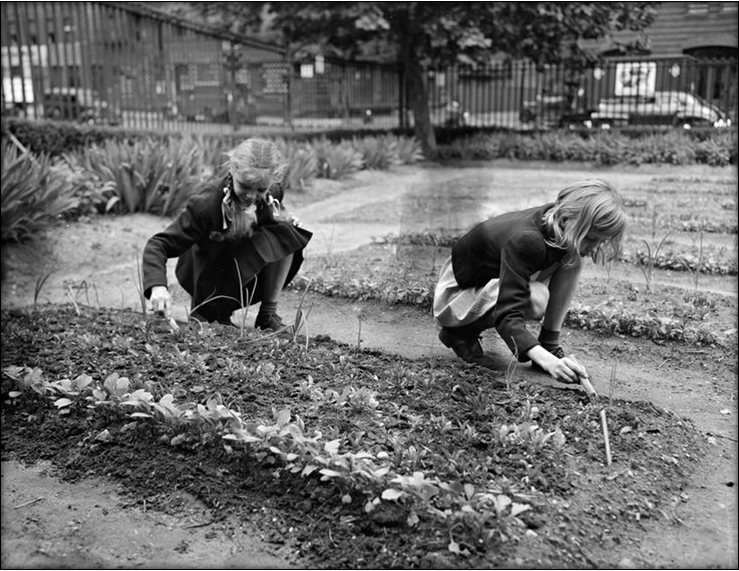
Personal gardens were mainstays for pioneers and have been so for many families, both rural and urban, through the centuries. A special time for family gardens was the Victory Garden Project that occurred during WWII. The slogan of this program was “grow your own, can your own.” This stimulus to make home gardens served to free up a significant portion of agricultural production, packing, and transport resources for the war effort. The program also helped offset the shortage of agricultural workers caused by the induction of hundreds of thousands of workers into the Armed Forces.
Many Victory gardeners improved their health through increased physical activity, and their families enjoyed better nutrition. Also, many youths who otherwise would not have been exposed to the benefits of home gardens perhaps picked up a healthful activity to carry forward into their own adulthoods. Historians estimate that by 1944, some 20-million victory gardens were planted which produced about eight million tons of food!
The idea of the victory garden is still with us, but often motivated by a slightly different rationale. Some gardeners, in addition to producing wholesome food, strive to achieve a healthy ecosystem. Some, in addition to growing time-proven types of food, experiment with more drought-resistant plant varieties and/or include plantings to promote wildlife.
The Victory Garden Project surely gave many youth a chance to do something they probably would not have done: dig in the soil and discover an entirely different world that lies just beneath their feet.
Some armchair philosophers remark that fishing and hiking are the poor man’s psychiatry. Perhaps gardening deserves to be on that list.

Development Director

Health Services Director

Community Relations Director